

BP Oil Spill Apology
The BP spill in the Gulf of Mexico began on April 20, 2010 after an explosion on the Deepwater Horizon Macondo oil well drilling platform killed 11 workers and injured several others.
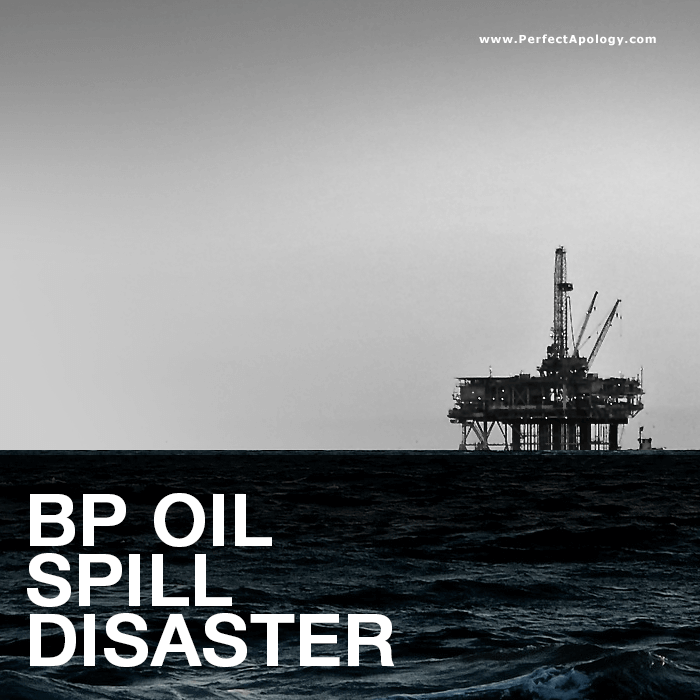
The environmental disaster resulted in 4.9 million barrels of crude oil being dispersed into the Gulf at a rate of 53,000 barrels a day until the leak was capped on July 15, 2010.
This particular accident remains the largest and most destructive oil spill since the infamous Exxon Valdez catastrophe in 1989 and likely the most costly.
BP Oil Spill Facts
The environmental impact of the BP oil spill has continued to affect the entire gulf region even today.
The spill permanently damaged marine and wildlife habitats across the Gulf coast region and devastated the fishing and tourist industries.
About 4,200 miles of the Gulf coast remained off limits to shrimpers who continued to find tar balls in their nets. About 320 miles of shoreline across Louisiana remained affected by the BP oil spill and wetlands (marsh grass) throughout the region continued to die for years.
Much of the BP oil spill settling on the sea floor is not degrading and research has confirmed disturbing statistical spikes in the number of dead dolphins that are washing up on Gulf shorelines.
BP Oil Spill Response & Communications
The mistakes were compounded by BP's terrible approach to critical risk communication and management.
The initial communication strategy passed on the responsibility to others and appeared to be both callous and heartless.
It's very likely that the many PR mistakes had something to do with previous decisions by CEO Tony Hayward to slash the company's public and government relations budget—the very expertise BP could have used to manage the current crisis.
Following the BP oil spill disaster company executives were forced to rely on outside consultants who didn't know the company, the region or its people.
In this context, it's easy to understand why Hayward's comments during the crisis, just made things that much worse.
...There's no one who wants this thing over more than I do. You know, I'd like my life back.
Hayward's callous statement was essentially the tipping point in an environmental and public relations catastrophe that got progressively worse for the company. As one former senior BP employee commented,
The only time Tony Hayward opens his mouth was to change feet
The company simply did not have a public relations strategy designed for this particular crisis and was forced to learn an important lesson about contracting public relations firms.
Hayward, most experts concluded, was the wrong person to apologize, or to lead BP out of this BP oil spill crisis.
The BP Oil Spill Apology
The BP oil spill generated several apologies, among the most prominent was the one included in the company's apology commercial.
The term commercial is appropriate here—although CEO Hayward stated that he was deeply sorry for the crisis, the commercial appeared to many cynics as a blatant effort at self-praise for everything BP has been doing to take responsibility for the accident and compensate those affected.
The biggest error in the misdirected PR strategy was Hayward's statement,
We will get this done, we will make this right.
The implication of the message was that everything was under control when, in fact, it was obviously out of control and unmanageable. The commercial reinforced the impression that BP was more concerned about damage control than actually stopping millions of barrels of oil from leaking into the Gulf.
The company was also criticized by industry experts and crisis communication consultants as a textbook case for how NOT to manage a crisis—initially BP executives tried to pass off the blame to contractors responsible for designing the blow-out safety valve.
The failure on BP's part to take immediate command of (and responsibility for) the situation lost valuable time, which exacerbated the crisis.
The more difficult the crisis became (by not immediately taking the lead to bring in as many government and industry experts as possible), the more damaging the consequences became, and the more challenging it was to craft the perfect (acceptable) apology.
This was a difficult lesson for BP executives to learn but it is a lesson that is consistently repeated in similar crises, for similar reasons.
The online apology was not much better
Eleven people died as a result of the accident and others were injured. We deeply regret this loss of life and recognize the tremendous loss suffered by the families, friends and co-workers of those who died. We regret the damage caused to the environment and livelihoods of those in the communities affected. We are putting in place measures to help ensure it does not happen again.
Regretting the loss of life or the damage caused by the mistakes does not constitute an apology—it does, however, constitute an effort by BP to avoid the legal implications and financial costs of accepting full responsibility.
BP Oil Spill Causes & Congressional Testimony
The more lengthy (and carefully crafted) apology for the BP oil spill came in the form of Hayward's Congressional Testimony, which went into considerable detail about the specific circumstances, the efforts to address the leak, and the company's plans to compensate those affected.
Chairman Stupak, Ranking Member Burgess, members of the Subcommittee. I am Tony Hayward, Chief Executive of BP plc.
The explosion and fire aboard the Deepwater Horizon and the resulting oil spill in the Gulf of Mexico never should have happened—and I am deeply sorry that they did. None of us yet knows why it happened. But whatever the cause, we at BP will do what we can to make certain that an incident like this does not happen again.
Since April 20, I have spent a great deal of my time in the Gulf Coast region and in the incident command center in Houston, and let there be no mistake—I understand how serious this situation is.
This is a tragedy: people lost their lives; others were injured; and the Gulf Coast environment and communities are suffering. This is unacceptable, I understand that, and let me be very clear: I fully grasp the terrible reality of the situation.
When I learned that eleven men had lost their lives in the explosion and fire on the Deepwater Horizon, I was personally devastated.
Three weeks ago, I attended a memorial service for those men, and it was a shattering moment. I want to offer my sincere condolences to their friends and families—I can only imagine their sorrow.
My sadness has only grown as the disaster continues. I want to speak directly to the people who live and work in the Gulf region: I know that this incident has profoundly impacted lives and caused turmoil, and I deeply regret that.
Indeed, this is personal for us at BP. Many of our 23,000 U.S. employees live and work in the Gulf Coast region.
For decades, the people of the Gulf Coast states have extended their hospitality to us and to the companies like Arco and Amoco that are now part of BP. We have always strived to be a good neighbor. We have worked to hire employees and contractors, and to buy many of our supplies, locally.
I want to acknowledge the questions that you and the public are rightly asking. How could this happen? How damaging is the spill to the environment? Why is it taking so long to stop the flow of oil and gas into the Gulf?
And questions are being asked about energy policy more broadly: Can we as a society explore for oil and gas in safer and more reliable ways? What is the appropriate regulatory framework for the industry?
We don't yet have answers to all these important questions. But I hear the concerns, fears, frustrations—and anger—being voiced across the country.
I understand it, and I know that these sentiments will continue until the leak is stopped, and until we prove through our actions that we will do the right thing. Our actions will mean more than words, and we know that, in the end, we will be judged by the quality of our response. Until this happens, no words will be satisfying.
Nonetheless, I am here today because I have a responsibility to the American people to do my best to explain what BP has done, is doing, and will do in the future to respond to this terrible incident. And while we can't undo these tragic events, I give you my word that we will do the right thing.
We will not rest until the well is under control, and we will meet all our obligations to clean up the spill and address its environmental and economic impacts.
From the moment I learned of the explosion and fire, I committed the global resources of BP to the response efforts. To be sure, neither I nor the company is perfect. But we are unwavering in our commitment to fulfill all our responsibilities.
We are a strong company, and nothing is being spared. We are going to do everything in our power to address fully the economic and environmental consequences of this spill and to ensure that we use the lessons learned from this incident to make energy exploration and production safer and more reliable for everyone.
....BP is a "responsible party" under the Oil Pollution Act. This means that federal law requires BP, as one of the working interest owners of Mississippi Canyon 252, to pay to clean up the spill and to compensate for the economic and environmental impacts of the spill.
Let me be clear: BP has accepted this responsibility and will fulfill this obligation. We have spent nearly $1.5 billion so far, and we will not stop until the job is done.
It is important to understand that this "responsible party" designation is distinct from an assessment of legal liability for the actions that led to the spill. Investigations into the causes of the incident are ongoing, and issues of liability will be sorted out separately when the facts are clear and all the evidence is available. The focus now is on ensuring that clean-up, and compensation for those harmed by the spill, are carried out as quickly as possible.
....The question we all want answered is "What caused this tragic accident"?
A full answer to this and other questions must await the outcome of multiple investigations now underway, including a joint investigation by the Departments of Homeland Security and Interior (Marine Board) and an internal investigation by BP itself.
...I understand people want a simple answer about why this happened and who is to blame. The truth, however, is that this is a complex accident, caused by an unprecedented combination of failures. A number of companies are involved, including BP, and it is simply too early to understand the cause. There is still extensive work to do.
.... Based on what happened on April 20, we now know we need better safety technology. We in the industry have long relied on the blowout preventer as the principal piece of safety equipment. Yet, on this occasion it apparently failed, with disastrous consequences. We must use this incident as a case study to avoid a similar failure in the future.
Since the April 20 explosion and fire, BP has been carefully evaluating the subsea blow-out preventers used in all our drilling operations worldwide, including the testing and maintenance procedures of the drilling contractors using the devices.
We will participate in industry-wide efforts to improve the safety and reliability of subsea blowout preventers and deep water drilling practices. And we will work closely with other interested parties as we do so.
We understand the seriousness of the situation. We know the world is watching us. No one will forget the 11 men who lost their lives in the explosion on the Deepwater Horizon.
We hear and understand the concerns, frustrations, and fears that have been and will continue to be voiced. I understand that only actions and results, and not mere words, ultimately can give you the confidence you seek. We will be, and deserve to be, judged by our response.
I give my pledge as leader of BP that we will not rest until we stop this well, mitigate the environmental impact of the spill and address economic claims in a responsible manner.
No resource available to this company will be spared. We and the entire industry will learn from this terrible event and emerge from it stronger, smarter and safer.
Tony Hayward
BP Oil Spill Apology Review
Unfortunately for Hayward, his testimony came across as cold and stale—an impression that was reinforced during a barrage of harsh questions coming from angry committee members who began to push hard for answers Hayward avoided or could not provide.
This a good example of how a perfect apology is difficult if followed immediately by dozens of pointed questions posed by politically motivated Congressmen committed to demonstrating to their constituency how committed they are to protecting public interests.
Each question (and non-answer) created the strong impression that BP should be apologizing for more mistakes. When the questions remained unanswered, because of Hayward's fears of further litigation down that line, the entire exchange came across as anything but an apology.
In fairness to Hayward, this was a very tough crowd.
Clearly, Congressional testimony is probably the worst possible place to convey a sincere apology, because it's impossible in such a politically divisive forum (where both parties are competing for public approval) for an apology to be accepted.
As BP's primary spokesperson, Hayward came across as stiff and excessively concerned about the legal implications of acknowledging blame, at least (as he explained) before all the evidence was in.
His main objective was pretty evident: protect BP against subsequent legal suits. As expected, BP is proceeding with its suit against the company responsible for designing the valve that failed.
In sum, despite Hayward's initial apology, the actual exchanges with committee members created the strong impression that BP was not prepared to accept responsibility.
BP Oil Spill Costs
The other problem with the BP oil spill apology is the sheer enormity of the crisis and consequences to so many lives, businesses and, of course, the environment.
It is very difficult to issue an acceptable apology when the consequences of the mistake continue to proliferate over months and years, creating new demands for compensation and more apologies.
This was not unlike an uncontrollable virus multiplying to the point where apologies, if continuously issued, lose any credibility or meaning.
With respect to compensation, most people accepted the final amount as respectable.
As part of the restitution package for the BP oil spill, BP executives agreed on June 16 (2010) to a $20 billion fund to compensate victims and industries harmed by the spill. In a BBC News article published in 2015, Bob Dudley the chief executive of BP said that Deepwater liabilities to date were at $44bn.
However in a Press Release issued by the company in 2016 it states that,
...This would bring the total cumulative pre-tax charge relating to the Deepwater Horizon incident to $61.6 billion.
Finally, an article from Reuters dated January 2018 states that the BP Deepwater Horizon costs ballooned to $65 billion.
The fund administrator at the time, hired by the White House to distribute compensation for the BP oil spill, Kenneth Feinberg, was consistently criticised for the slow pace of distributing the funds and the added requirement that those accepting quicker, but lower paying compensation packages, were required to waive their right to any future legal actions against BP.
BP Oil Spill Apology Rating
For a slow start to accepting full responsibility, poor crisis management strategies, excessive concerns about litigation associated with admitting fuller responsibility (in hopes of maintaining a stronger position when suing the blowout valve developer), BP loses marks.
However, the company does gain a few marks for compensation, but again loses a few for the pace of compensation. Ten years later and parts of the story continue to this day.
APOLOGY RATING → 3/10
Read other corporate case studies or learn what questions to ask before issuing a public apology.