

The High Value of a Perfect Business Apology
The value of a business apology can actually be measured.
In fact, the willingness of wronged parties to accept an offer of reconciliation, even one that comes with a significant loss in revenue, is considerably higher if and when an apology is forthcoming.

The key is an apology, but not any apology— when the ingredients of a perfect business apology are met, the probability of reconciliation rises considerably.
A major research project by Edward C. Tomlinson, Brian R. Dineen and Roy J. Lewicki, published in the Journal of Management, confirms many of the most important recommendations we offer throughout our business pages.1
The researchers selected 90 graduate business students with an average of six years of work experience. The respondents ranged in age from 23-46, roughly half male and half female.
Each respondent was asked to consider his/her reaction to 48 different scenarios involving a business transaction.
As the researchers explain,
We presented background information to each participant that described a negotiation situation between two small business owners.
In this background information, a violation in a negotiated agreement was described, along with supporting financial loss figures suggesting a high or low magnitude of violation. p. 175
To explore the conditions under which the respondents were more/less likely to reconcile, the business research study examined several variables—the nature of the apology (accepted responsibility or passed blame), the timeliness of the apology (immediate or delayed), perceived sincerity, the nature of the prior relationship (good or poor), the probability of future violation (likely or not likely to happen again).
The following is an example of one of the 48 scenarios respondents considered before stating whether they would terminate the business relationship or reconcile:
You and Pat have had a good business relationship in the past. After Pat told you about the reduced order, Pat did not seem to be in much of a hurry to explain the adjustment.
When Pat apologized, Pat said it was not controllable and was due to business dropping off. It appeared that this apology was sincere. After thinking about Pat's behavior, you decided that this is probably an isolated event. p. 176
Business Apology Research on Trust & Reconciliation
After reading each of the 48 scenarios, the respondents were asked to rate the likelihood of continuing to work with the customer, and their willingness to reconcile was determined by their answers to the following types of questions:
What is the likelihood that you would continue a business relationship with Pat?
To what degree are you willing to let Pat try to reconcile the relationship with you, given Pat's actions?
How difficult would it be to rebuild your relationship with Pat back to the point where it was before Pat changed the order?
The results and findings of the business study are depicted below.
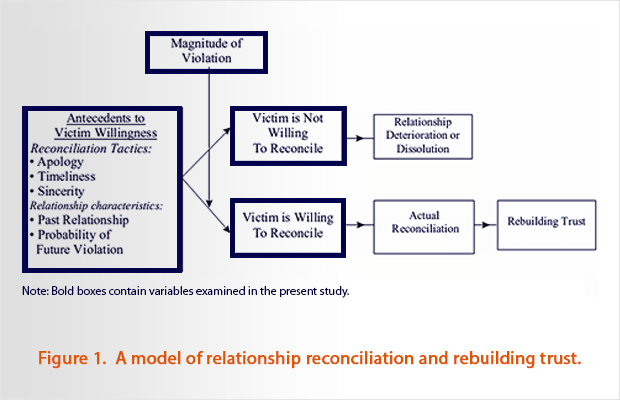
The model illustrates the typical path through which offenders can rebuild trust in a business relationship damaged by a serious and costly business infraction.
The Value of a Sincere Business Apology In Reconciliation
The value of the apology, if it succeeds, can be measured by the willingness of the victim to reconcile—essentially accepting the losses and moving on.
Tomlinson, Dineen and Lewicki have found that most companies are likely to terminate a business relationship following a serious infraction, and usually refuse to reconcile because of the lost revenues.
But this business research has shown that the probability of reconciliation is higher if an apology is forthcoming, even in cases where losses are great.
The findings also confirm that that 'sincerity' produced one of the strongest main effects
...sincerity magnified the beneficial effect of an apology... Efforts to simply placate the victim following a transgression may yield dim prospects, whereas sincere apologies are more effective regardless of the attribution given in the apology.p. 181
Research Conclusions & Practical Business Implications
The business research data led to the following conclusions, all of which convey several obvious practical business implications:
1. "Offenders should always give an explicit apology in the wake of a trust violation."
Most victims expressed appreciation after receiving an apology and were far less likely to reconcile in the absence of one.
2. In addition to issuing a formal apology, the business research also found that "offenders should strive to respond in a timely manner that conveys sincere regret for the harm imposed on the victim."
A relatively quick and sincere apology is crucial to success.
3. To the extent that the offender accepts "personal culpability for a violation" the victim is more likely to accept the apology and move on to reconciliation.
But the study also shows that repeated apologies often backfire—even apologies that accept personal responsibility "may be likely to diminish the perceived effectiveness because the offender may not appear to be sincere."
The lesson here is that credibility, an important component of any business relationship, is a function of how selective and sincere the apology appears to be.
4. Consistent with a key ingredient of perfect apologies, the business research data also demonstrates that some form of restitution helps.
"Offenders are urged to seek out ways to minimize the harmful impact of the violation on the victim. Severe violations are difficult to reconcile, and they may prompt the victim to scrutinize the past relationship history more carefully when assessing their willingness to reconcile."
The implications are obvious—creating, sustaining and nurturing a long and healthy business relationship is the best foundation for dealing with the occasional mishap. In these cases an apology is likely to be much more believable and effective.
5. Finally, "offenders should consider the complete context of their relationship history with their colleagues.
Actions of the past and an awareness of the victim's expectations about what will take place in the future will heavily impact willingness to reconcile, and may override the impact of any short-term reconciliation tactics."
The research found that a promise that serious efforts will be made to avoid similar infractions in the future, along with some form of restitution or payback, will go a long way to re-establishing confidence and trust.
According to Tomlinson,
There's a tension when you have hurt someone in a business relationship.
We know that giving an apology and taking blame may help the victim.... Long before any violation arises, business people need to be laying the groundwork for a good, healthy relationship.
A good previous relationship can do as much to help repair damage from a failed business deal as any apology.2
For more information on the value of a perfect business apology, review some of the other case studies we've compiled in our research section.
1 - The Road to Reconciliation: Antecedents of Victim Willingness to Reconcile Following a Broken Promise, by Edward C. Tomlinson, Brian R. Dineen and Roy J. Lewicki. Journal of Management, 2004 30 (2) pp. 165-187.
2 - Quoted in an interview with Jeff Grabmeier (June 1, 2004) -- researchnews.osu.edu/archive/bustrust.htm)