

Medical Errors & Full Disclosure
There are three guiding principles at the center of the Full Disclosure/ Early Offer Movement, all of which are designed to encourage full disclosure for medical errors with fair, upfront and early compensation.1
1. Compensate quickly and fairly when inappropriate medical care causes injury;
2. Defend medically appropriate care vigorously;
3. Reduce patient injuries (and therefore claims) by learning from mistakes.
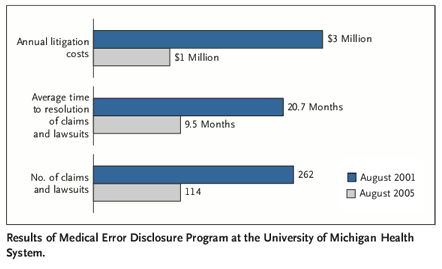
These three basic principles have been shown repeatedly to reduce anger, lead to fewer lawsuits with lower settlements, decrease litigation costs, shorten the time required to settle cases (months instead of years), eliminate many non-meritorious cases, reduce the overall number of medical errors, and, perhaps most important, lead to satisfied patients and families.
According to Doug Wojcieszak (founder of SorryWorks.net a coalition dedicated to providing "middle ground" solutions to the medical malpractice crisis by telling patients the whole truth) the following are among the more important conflict resolution and mediation procedures to initiate after medical errors:2
2. expressing your concern and laying out the next steps in the course of care;
3. notifying your insurance company, risk management staff and legal counsel;
4. arranging to meet with the family and their legal counsel to fully explain what happened and how you are going to fix it.
Medical Apology Momentum in The U.S.
An increasing number of state governments, hospitals and insurance companies are realizing the incredible monetary and professional advantages that come with quick medical apologies—in fact "I'm Sorry" laws are gaining widespread acceptance across the United States.
Thirty-nine states along with Guam and the District of Columbia have enacted laws and/or have provisions regarding medical professionals and apologies that focus on excluding expressions of sympathy or sympathetic gestures after accidents as proof of liability. They are:
- Alaska
- Arizona
- California
- Colorado
- Connecticut
- Delaware
- District of Columbia
- Florida
- Georgia
- Guam
- Hawaii
- Idaho
- Illinois
- Indiana
- Iowa
- Louisiana
- Maine
- Maryland
- Massachusetts
- Michigan
- Missouri
- Montana
- Nebraska
- New Hampshire
- New Jersey
- North Carolina
- North Dakota
- Ohio
- Oklahoma
- Oregon
- Pennsylvania
- South Carolina
- South Dakota
- Tennessee
- Texas
- Utah
- Vermont
- Virginia
- Washington
- West Virginia
- Wyoming
The many obvious reasons for the increasing popularity of these laws were explained by Robert J Walling and Shawna S. Ackerman in 2006:
Apology laws appear to have the potential to reduce overall medical malpractice liability costs by lowering the amount of lawsuits, attorney fees, and claim costs.
Additionally, studies show that physician apology laws encourage open communication, reporting, and investigation of errors, thereby providing an opportunity to prevent future errors….
The Bureau of Veterans Affairs (VA) hospital in Lexington, Ky., is often cited as an example of effective medical error communications policy… Besides encouraging expressions of sympathy and admissions of fault, the VA actively seeks to disclose medical errors and offers direction on how to file a claim…
This policy of extreme honesty, practiced since the late 1980s, has reportedly reduced lawsuits and settlement and defense costs. Only three cases have gone to trial in 17 years, with the average settlement being $16,000, compared with the national VA average of $98,000. 3
Many insurance companies jumped on the full disclosure/early offer bandwagon, for very sound reasons. Med Pro, for example, began to offer a 5% premium discount for insured physicians who participate in the company's accredited risk management education program. 4
Again, one of the key goals of the program was to dispel mistaken assumptions held by hospital administrators and doctors that "greed" rather than "anger" is the central motivation for malpractice lawsuits.
And the Federal Government followed suit, through active sponsorship, at the time, by then Senators Hillary Rodham Clinton and Barrack Obama, and pushed medical liability reform by emphasizing the benefits of "I'm Sorry" legislation.
Clinton and Obama actively sponsored the National Medical Error Disclosure and Compensation (MEDiC) bill.5 In their article published in the New England Journal of Medicine, Clinton and Obama (2006) cited the following evidence from the University of Michigan's medical errors disclosure program.6
Similar results were produced when a medical malpractice insurance company in Denver, Colorado began a new program recommending the use of apologies and quick settlements. According to figures reported in the Hartford Courant (2005)
...payments to aggrieved patients were under $6,000, compared with about $284,000 for doctors not in the program. 7
Similarly, when the Veterans Administration Hospital in Lexington, Kentucky, instituted full disclosure/early compensation procedures in their system,
...the number of settlements increased, but the size of the settlements decreased and lawsuits became rare. In the first sixteen years of the program, only three lawsuits went to trial. Furthermore, defense litigation bills decreased significantly and the hospital saved money overall. Most importantly, doctor-patient relationships were preserved and medical errors reduced." 8
Responding to Skeptics of Full Disclosure/Early Offer
Of course, none of the preceding analysis should be taken to imply that there are no detractors or skeptics. Some studies have raised questions about the "inevitable" advantages of medical apologies.
One study by a group of researchers at Harvard University found that full disclosure and fair compensation certainly avoided trials, but many of these cases did not necessarily mean lower payouts.9 The Harvard study found that overall claims cost more with disclosure, not less.
But, to their credit, Sorry Works! included the study on their web site and offered a careful and systematic assessment of the project's methodology and underlying assumptions
The real experts are not medical, insurance, and legal professionals in a simulated study,
They go on to point out,
...but the patients and families who have actually experienced adverse medical events. Unfortunately, not even the most gifted researcher can replicate the positive emotional impact of disclosure on patients and families and how those feelings influence financial decisions and litigation.
The authors then go on to say that the Harvard report
did not study real-world institutions conducting disclosure!
Of course, notwithstanding the skeptics, the overwhelming body of research and evidence appears to strongly support the full disclosure early compensation strategy when medical errors occur.
Doctors & The Early Offer / Full Disclosure Movement
Studies have shown that doctors themselves are beginning to understand the problems and implications for patient care. In one survey of 2,637 American and Canadian doctors conducted by the University of Washington's School of Medicine:10
98 % supported disclosing serious errors to patients;
78 % supported disclosing minor medical errors;
58 % had disclosed an error to a patient;
85 % of those were satisfied with the disclosure;
66 % agreed that disclosing a serious error reduces malpractice risk.
As Wojcieszak explains...
...we're advocating good customer service. Without apology and disclosure, there can be no patients' safety because as long as you're covering up and denying, you're never going to learn."11
Wojcieszak stresses that Sorry Works! advocates real apologies, which includes admission of fault and upfront compensation.
These types of apologies take ownership of medical errors, remove the sting from most cases, and eliminate the anger that pushes most patients and families to file a medical malpractice lawsuit.
If a lawsuit is still initiated, these apologies make for a great defense because it is hard—if not impossible—for a plaintiff's attorney to make a jury/judge angry at a physician/hospital who tried to do the right thing, including offering fair compensation.
Evidence regarding the enormous financial and professional benefits of issuing a perfect medical apology when medical errors occur is simply too obvious to ignore. Those who remain committed to traditional risk management strategies will pay.
Read about medical errors, lawsuits and apologies or visit our homepage to explore other areas of the site.
1 - Quoted in www.sorryworks.net/files/CoalitionPowerpointpresenation.ppt #261,8, Goals of the Coalition
2 - Robert Redlin (2006) "Mistakes Happen." Physicians Practice. January 2006 -- www.sorryworks.net/media44.phtml
3 - Robert J Walling and Shawna S. Ackerman (2006) "Having to say your sorry: A More Efficient Medical Mal Practice Insurance Model."
4 - www.sorryworks.net/article44.phtml
5 - Peter Geier (2006) "Emerging med-mal strategy: 'I'm sorry'" National Law Journal Online. July 14, 2006 -- http://www.sorryworks.net/media49.phtml
6 - Hillary Rodham Clinton and Barack Obama (2006) "Making Patient Safety the Centerpiece of Medical Liability Reform." Perspective, May 25 -- www.sorryworks.net/pdf/Clinton_Obama.pdf
7 - Hartford Courant (2006) "When Doctors Say I'm Sorry." Sep 2, 2006 -- www.sorryworks.net/media37.phtml
8 - Doug Wojcieszak (2006) "The Sorry Works! Coalition," --www.sorryworks.net/WhatIs.phtml
9 - www.sorryworks.net/pdf/Harvard_Study.pdf
10 - Why Docs Won't Say Sorry." Health Day News. Monday August 14 www.sorryworks.net/article37.phtml
11 - Doug Wojcieszak (2006) "The Sorry Works! Coalition," --www.sorryworks.net/WhatIs.phtml