

How to Apologize: The Right Way to Say You're Sorry
Wondering how to apologize? How to say sorry and show true sincerity?
Apologizing to someone you've hurt—whether it's a partner, girlfriend, friend, or family member—doesn't have to be as hard as it seems. Understanding the right things to say, what to avoid, and how to deliver your apology can make all the difference.
An Effective Apology Should Always Include:
1. A detailed account of the situation
2. Acknowledgement of the hurt or damage done
3. Taking responsibility for the situation
4. Recognition of your role in the event
5. A statement of regret
6. Asking for forgiveness
7. A promise that it won't happen again
8. A form of restitution whenever possible
Here's a breakdown of each statement to help us understand how to apologize and say "I'm sorry" in the most effective way.
Provide A Detailed Account
Offering a clear account of what happened ensures mutual understanding. This validates the other person's feelings and helps clarify the situation. Be specific and focus on the particular event.
For example, if you missed an important date, don't say how sorry you are about your general absent-mindedness. Instead apologize for missing that specific date.
Acknowledge the Hurt & Damage Done
Acknowledging the hurt or damage done means you recognize the pain or harm caused while showing that you understand their perspective. This validates their reaction, even if others might have reacted differently.
Take Responsibility
Accept your role in the situation without making excuses. This demonstrates that you recognize your actions caused harm. Avoid defending or justifying yourself—it's about their feelings, regardless of intent.
Express Regret and Remorse
Show genuine regret and remorse and promise to avoid repeating the mistake
This step is crucial for rebuilding the relationship and starting the healing process. After all, there is no value in apologizing for something that you aren't sorry about or that you will do again and again.
Ask for Forgiveness
Finally, asking for forgiveness at the end of the apology gives the power back to the other person.
It signifies that you've sincerely apologized and are willing to make amends and offer a form of restitution if appropriate. The next step is theirs to take.
Now that you have the tools and understand what to say and how to say it, it's time to look at the 'Art of Apologizing'—how you actually deliver your apology.
How To Apologize & Deliver Your Apology
There are two basic approaches for delivery: saying I'm sorry with a verbal apology and writing an apology letter. Each has its own drawbacks and benefits.
1. Verbal Apologies—a verbal apology requires that you be prepared for the conversation that follows the apology AND the recipient's reaction whether it is positive or negative. So know what you want to say. Practice it in front of a mirror. And most importantly, be prepared to think on your feet!
2. Written Apologies—an apology letter gives the recipient the time to think about the situation and your apology, before responding.
With written apologies, you also need to consider how to deliver your letter of apology.
If you normally communicate with them via email then an email apology can be perfectly suitable. Now imagine the reaction if you send that same person an apology via snail mail.
The mere fact that you don't normally communicate in this way will underscore how seriously you're taking the situation and how truly sorry you are. It will have much greater impact.
Don't overthink this, but do consider these types of simple personality traits when you consider how best to deliver your apology.
How To Apologize: The Recipient & The Relationship
Apologizing effectively requires taking into account the recipient and your relationship. Consider the personality type of the recipient, their values, and the nature of your relationship with them. This will help determine the format & style of your apology.
For example, someone who doesn't like confrontation may prefer a written apology over a verbal one. Similarly, for older generations, a formal, handwritten apology is likely to be the most respectful and sincere approach.
WARNING: Always err on the side of assuming that the person who's been hurt views the situation as more serious than you might think.
The key is to ensure your apology resonates with the recipient and 'fits' with who they are, as this shows genuine sincerity—and sincerity is essential for them to accept your apology.
If the person is more of an acquaintance than a friend, and the infraction is minor, go with a more formal approach. Write a brief apology letter and send it to them by regular mail or email.
The closer the relationship, the more thought and care are required for your apology. Conversely, the more distant the relationship, the more formal and detached your apology can be.
If this is a close relationship and the infraction is major, then take them out for a coffee, lunch or dinner and apologize in person.
If the relationship is close and personal, you can go either way (written or verbal—or both). If you decide that a letter of apology is the right way to go, make sure it's handwritten, not typed, and never send it by email. A verbal apology in this case should be done in person and not over the phone.
Remeber that the tone of your apology should be based on the infraction. As a general rule, the more serious the infraction the more serious the tone.
KEY TAKEAWAY: The more strained the relationship the more thought and caring needs to go into your apology. This means you need to consider all the ramifications caused by your strained relationship and address these as well.
Finally, there is one other option that allows you to enjoy the benefits of saying I'm sorry through both a written and verbal apology. It's a hand-delivered written apology. It gives the recipient time to absorb the contents of your letter and can provide a better foundation for constructive dialogue and discussions.
How To Apologize: Verbal Apologies & Apology Letters
The most important thing to keep in mind is that a letter of apology gives the recipient something tangible to hold and the time to think over what you've written (and cool down, if necessary).
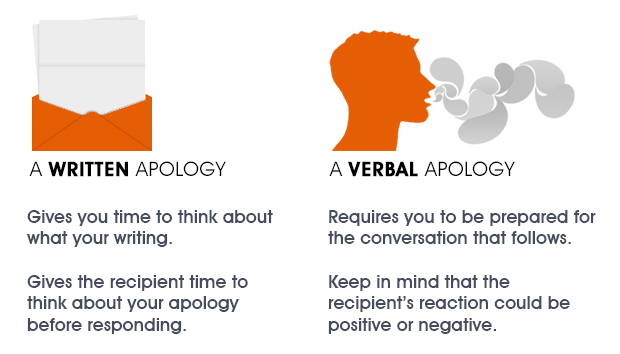
On the other hand, a verbal apology requires that your sincerity shines through and that you're prepared for whatever reaction and course the discussion takes, regardless of a positive or negative outcome.
Why Is a Verbal Face-to-Face Apology Sometimes Preferable
Personal Connection → A face-to-face apology allows for a genuine and direct connection. It demonstrates sincerity and commitment in a way that texts or calls simply can't match.
Non-Verbal Cues → Being present in the same space lets you convey seriousness and empathy through body language. Eye contact, facial expressions, and gestures can all reinforce your words and show your earnestness.
Immediate Feedback → Apologizing in person allows you to gauge the other person's reaction immediately. This enables you to address any concerns or misunderstandings on the spot, fostering a more effective resolution.
Building Trust → By making the effort to meet face-to-face, you show that the relationship is important to you. This can help rebuild trust and mend any rifts.
Avoiding Miscommunication → Written words or phone calls can sometimes be misconstrued. An in-person apology minimizes the risk of misinterpretation and ensures your message is clear.
Guidelines For How to Apologize in Person or By Phone
| How | When & Why |
|---|---|
Scheduled Meeting |
When the relationship is more formal (teacher, colleague, a friend's parent, shop owner etc.) and/or more distant—more often in a business setting. Letting a person know that you want to meet with them face-to-face for the simple purpose of saying I'm sorry is a respectful and courteous way of mending fences. |
Over Coffee or a Drink |
When the relationship is close and the mistake is not too severe. Inviting the person out for a coffee/drink has the same benefit as a scheduled meeting with the added element of an activity shared by friends. |
Over Lunch |
When this is part of your normal routine with the recipient or when you feel the gesture of a lunch invitation feels right. Usually appropriate when the mistake is a little more significant, or in cases where the recipient considers the mistake serious enough to be very hurt, insulted or angry. A lunch invitation lets the recipient know that a more lengthy discussion is in order, and that YOU think YOUR mistake is serious enough to warrant the additional time and that a more lengthy discussion is likely. The gesture of the invitation itself also becomes part of the apology. |
Over Dinner |
When the relationship is intimate or a friendship is strong. When a long discussion is necessary to convey the many reasons why your apology is important and a more formal evening meeting is warranted. Emotions can run high depending on the situation and infraction. A restaurant invitation will provide added protection from the negative effects of a very emotional reaction to your apology. However, take into consideration that the recipient may deserve the right to react emotionally (or tends to resolve issues more effectively through emotions). In that case, the invitation should be for a home cooked meal or delivery. |
By Phone |
When the relationship is more formal or not a close personal one. (e.g. parent/teacher, fellow club member etc...) Picking up the phone and saying I'm sorry in a timely manner is often the best way to make things right again. |
How to Apologize & Initiate an Apology Conversation Effectively
Starting an apology conversation can feel daunting, but with the right approach, it can lead to healing and understanding. Here's how to start on the right foot:
⏵ Seek Permission to Speak: Begin by asking, "Is this a good time to talk?" This simple question respects the other person's time and shows you're considerate of their availability. If they can't talk, follow up by asking when would be more convenient.
⏵ Choose an Appropriate Setting: Once permission is granted, find a quiet, private place where interruptions are minimized. A focused environment helps both parties engage openly and earnestly.
⏵ Practice Your Apology: Before diving into the conversation, rehearse your words. This is vital, especially if emotions are high. Practicing ensures your message remains clear and prevents an emotional outburst that might muddle your apology.
⏵ Avoid Long Narratives: Structure your apology so that it is direct and genuine, rather than a lengthy defense of your actions. Keep it succinct to make sure the other person understands your remorse without being distracted by excessive explanations.
⏵ Stick to the Essentials: Know what you want to convey ahead of time. Apologies don't need to be elaborate to be effective. A clear, heartfelt apology is often more impactful than a long-winded one.
Following these steps can create a foundation for a productive and sincere apology conversation. Remember, the goal is to foster understanding and move forward positively.
How To Apologize To Your Girlfriend Or Boyfriend
For intimate relationships, when you're trying to figure out how to apologize to someone you hurt, like a girlfriend or boyfriend, husband or wife, a verbal apology is always warranted. However with these types of close personal relationships, consider both a verbal and written apology.
We like starting with a written apology that includes an invitation for a coffee/meal/drink etc. where you'll deliver a verbal follow up and discuss the situation now that everything is on the table.
With important personal relationships, especially when you've truly hurt someone, this two-prong approach gives you the benefits of both verbal and written apologies that we noted above, but more importantly it shows how much you care about the recipient and the relationship.
Another consideration when it comes to a girlfriend, boyfriend, lover or spouse, is bringing a little romance to your apology.
Adding a touch of romance can go a long way. A short heartfelt apology message to your love can help remind them how special your relationship is and why you're together in the first place.
You don't need to stop there, think about including a romantic poem, quotes on apologizing, or even sending a bouquet of flowers—flowers are a classic apology gift for a reason.
Or add some lyrics from a favorite song you both love or some relevant lyrics from our list of best apology songs.
Be creative. Is there something special that they've wanted or hinted about? Is there something out of character for you to offer them as a gift that shows how sorry you are and that you're really trying to make amends?
WARNING: Offering a thoughtless random gift will more often than not reflect poorly on your sincerity. After all, if you haven't taken the time to find something special then how important can the relationship be to you?
If you want to include an apology gift but can't come up with anything relevant or desired by the recipient then go with something corny—flowers, candy, or even a customized T-Shirt that says 'I'm Sorry'—corny works well as a token gesture in romantic relationships.

How to Apologize To A Friend
Apologies between friends should reflect the friendship.
For life-long friends, draw on something in your history together that shows how important the friendship is to you and how sorry you are for putting it at risk.
If the infraction is serious, make sure that your apology reflects that you understand the severity of what you've done—use more formal language and an appropriate setting.
For any friendship that is important to you, a token gesture or gift between friends can be very effective in demonstrating how much you've thought about the situation, especially if the gift is tailored to the recipient and your friendship.
How To Apologize FAQs
The following FAQs are based on the questions most frequently asked by our readers in their attempt to understand how to apologize.
Where do I start for an effective apology?
Take the time to reflect and appreciate what you did wrong. Look at it from all sides, especially the side of the person you offended.
Gather your thoughts, take full responsibility, and use words that are clear and precise. Be absolutely honest, don't exaggerate or skew any thing for any reason—it will undermine your apology's sincerity.
Which is more effective, a written or a verbal apology?
Choose the one that plays to your strengths. An apology letter is a better option if you're generally nervous or get hyper, don't do well with face-to-face confrontations, and have difficulty expressing yourself on the fly.
A verbal apology is best when you are comfortable expressing your true feelings without letting your emotions get in the way. Both can be effective when done properly so go with the one that feels better for you and your situation.
How do you show sincerity when apologizing?
Make sure the apology clearly demonstrates your understanding of why the recipient was injured by your actions, and how much they were hurt. Saying "I know you're hurt" is different from "I know how angry and betrayed you feel..."
The former shows a general understanding while the latter tells them that you've put yourself in their shoes and given thought to the consequences of your actions.
What should I avoid for an effective apology?
Don't use qualifiers or suggest in any way that you're sharing responsibility. Avoid trying to evoke sympathy or demand forgiveness. Avoid using any form of conditional wording, such as 'but' or 'if'. Saying 'I’m sorry if I hurt your feelings' shifts the responsibility away from yourself and makes the apology sound insincere. It suggests uncertainty about the impact of your actions, which can come off as dismissive.
Visit our apology DOs and DON'Ts pages for some quick tips and secondary considerations.
Also consider checking out this Berkeley article on The Three Parts of an Effective Apology which sums up nicely why simply saying "I'm Sorry" isn't enough for a sincere and effective apology.
Mastering How to Apologize with Confidence
Apologizing for many of us can be difficult. However, our level of discomfort is usually relative to the offense.
Most of us have no problem saying I'm Sorry when we accidentally bump into someone on the street. In fact that type of situation is so common to us that the ensuing apology has become a reflex—an automatic response with natural timing.
But what happens when we have to think about how to apologize?
When we think about apologizing, we naturally reflect on the actions that led up to it. Our thoughts, emotions, and pride get tangled in the process, often bringing feelings of embarrassment, shame, or discomfort. These emotions can make us feel stuck, convincing us that we don’t know how to apologize—when, in reality, now we do.
The good news? If we were constantly messing up, apologizing would come as easily as saying “sorry” when we bump into a stranger. The very fact that we struggle with how to say sorry means that, for the most part, our behavior is on the right track.